How to Apply for Universal Credit if You’re Self-Employed: A Complete 2026 Guide
Disclaimer: This is an independent informational portal. We are not affiliated with, endorsed by, or connected to any UK government body, council, or the Home Office. All information is provided for guidance purposes only. Always check the official GOV.UK website for the most up-to-date and legally binding information.
Introduction
Being self-employed and on a low income can feel like a juggling act. You’re trying to grow your business, manage unpredictable earnings, and cover your living costs — all at the same time. If you’re struggling financially, Universal Credit (UC) can help.
But applying for Universal Credit when you’re self-employed is not the same as applying as an employee. There’s a gateway interview, a minimum income floor, and monthly reporting requirements that don’t apply to PAYE workers. This guide walks you through every step of the process in plain English.

We are an independent informational portal — not the DWP, not Jobcentre Plus, and not affiliated with any government body. Always verify details on GOV.UK before making decisions.
Am I Eligible to Claim Universal Credit as a Self-Employed Person?
You can claim Universal Credit if you are self-employed, but you must meet the standard UC eligibility criteria first.

To qualify, you must:
Be aged 18 or over (with some exceptions for 16–17 year olds)
Be under State Pension age
Live in the UK
Have savings and capital below £16,000 (this includes money in bank accounts, ISAs, and investments)
Not be in full-time education
Accept the claimant commitment — the conditions you agree to meet to receive UC
If you have a partner, you must make a joint claim. Your combined savings and earnings will be assessed together.

Being self-employed does not automatically disqualify you. In fact, Universal Credit is designed to support self-employment where it is the best route to financial independence.
Information gap: For a full breakdown of Universal Credit eligibility rules, read our guide on who can claim Universal Credit in 2026.
Step 1: Report That You’re Self-Employed

When you start your Universal Credit claim online, you must report that you are self-employed. You need to do this if you are:
Trading through a limited company
Working as a subcontractor or contractor
Working for yourself
Working in the gig economy, such as short-term or temporary contracts
Even if your self-employment is a sideline to a paid job, you still need to declare it to the DWP.
You should report your work status through your Universal Credit online account. If you are already claiming UC and become self-employed later, report the change through your journal as soon as possible.
Important: Foster carers should note that Universal Credit does not treat foster care as self-employment. You do not need to report your foster care allowance as self-employed income.
Step 2: Attend Your Self-Employed Interview (Gateway Interview)
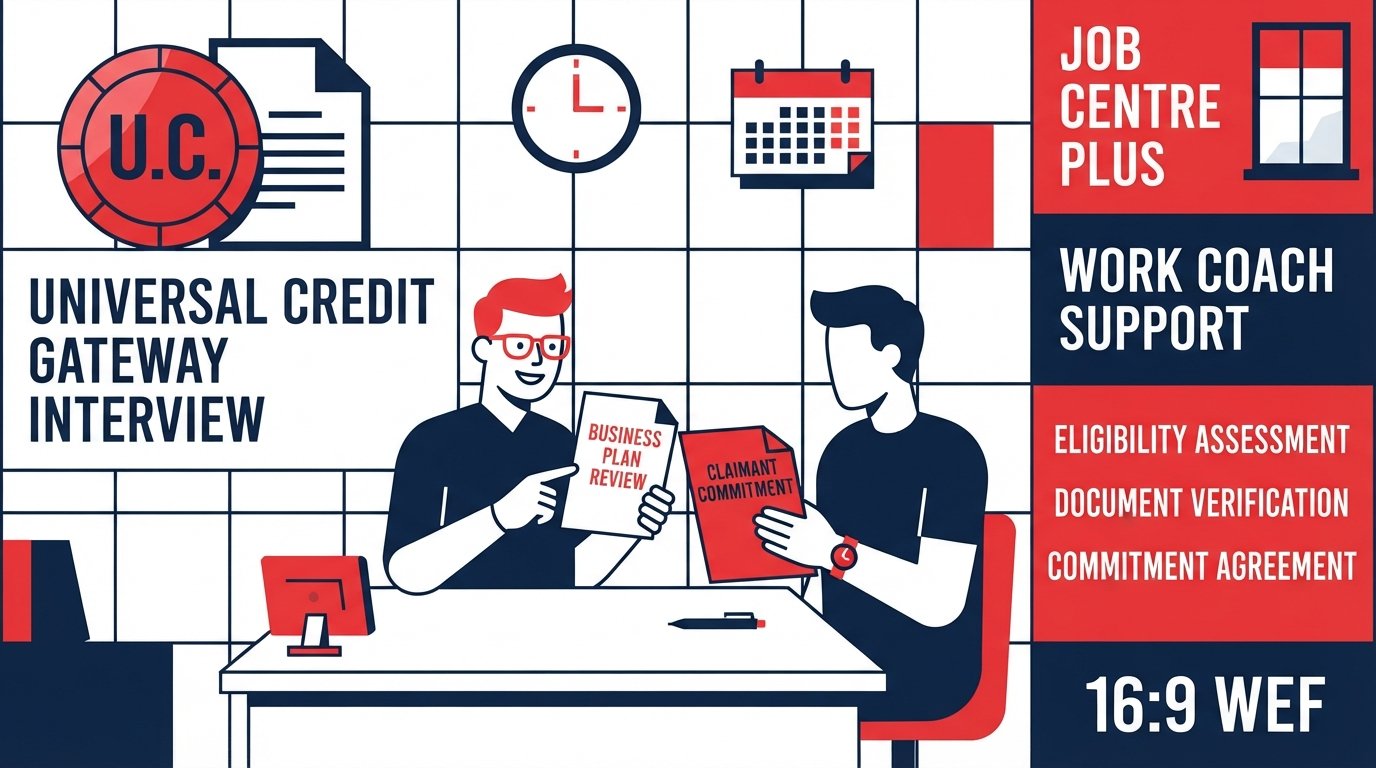
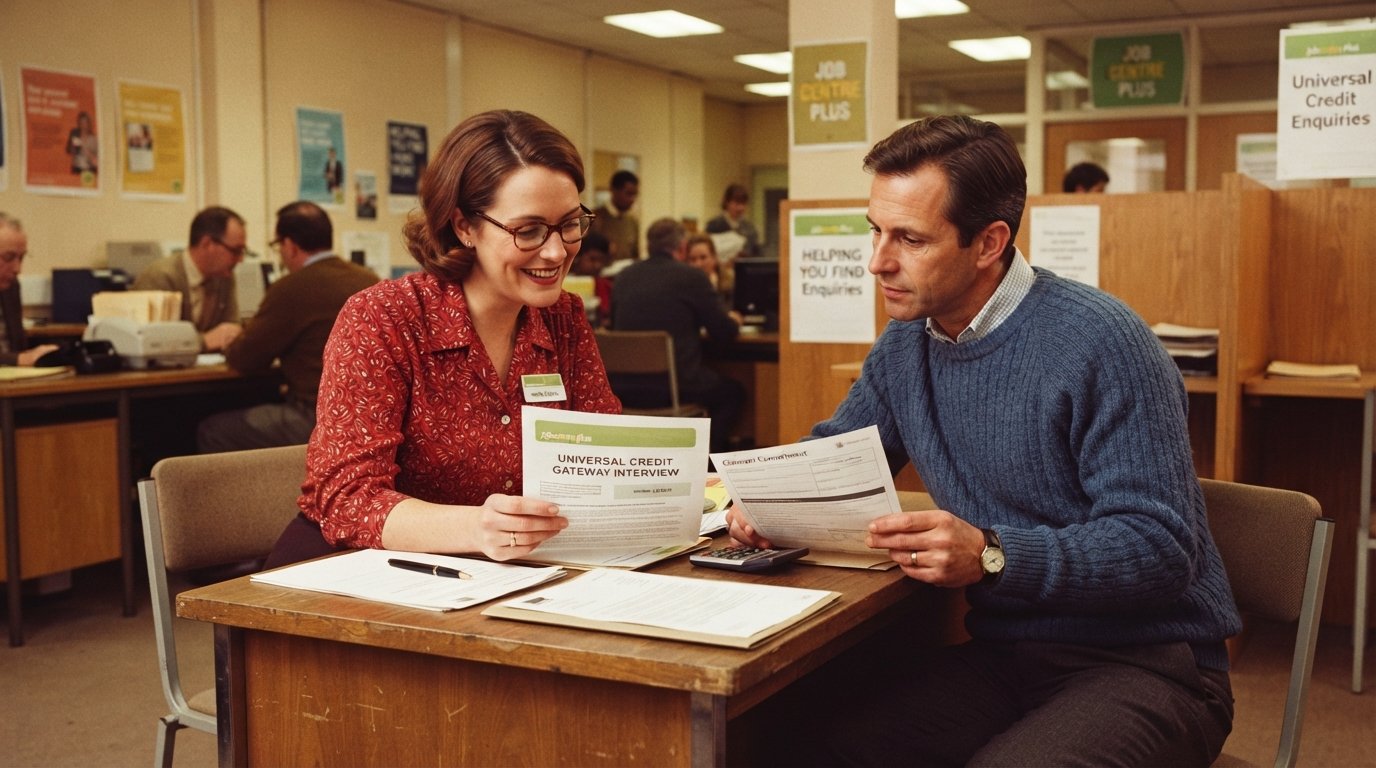
Once you tell the DWP you’re self-employed, you will be invited to a self-employed interview — sometimes called a Gateway Interview — with a work coach at your local Jobcentre Plus office.
If you do not attend this interview, you may not be able to get Universal Credit.
At the interview, the work coach will decide three things:
Whether you are “gainfully self-employed”
Whether you qualify for a start-up period
Whether your business could have a similar setup to a sole trader if you trade through a limited company
What “Gainfully Self-Employed” Means
You are considered gainfully self-employed if your self-employed work is:
Your main job or main source of income
Organised — for example, you keep records of your business activities
Developed — for example, you have a business plan or are advertising your work
Regular — for example, you have steady work now and in the future
Expected to make a profit
If you can prove all of these things, you are gainfully self-employed. This means you do not have to look for other work while claiming UC. If you cannot prove all of these things, you may have to look for other work to claim Universal Credit.
What to Bring to Your Interview
Bring as much evidence as you can — paper or digital copies are both accepted. The more evidence you provide, the smoother the process will be.
Business details:
Business name
Business address
The date you first started trading
Your Unique Taxpayer Reference (UTR) from HMRC, if you have one
VAT registration number, if you’re VAT registered
Business records:
Invoices
Receipts
Bank statements
Tax returns
Records of customers, suppliers, or contracts
Business activities:
Your business website
Business social media accounts
Marketing materials
A business plan or portfolio
Other supporting evidence:
Letters from HMRC and other official sources
Payslips if you also work for someone else
Business certificates, such as insurance or professional accreditation
Information gap: For a detailed checklist of documents for your gateway interview, read our guide on preparing for your self-employed Universal Credit interview.
Step 3: Understand the Minimum Income Floor (MIF)
The Minimum Income Floor is the most important thing to understand about claiming Universal Credit when self-employed. It is also the most misunderstood.
What Is the Minimum Income Floor?
The Minimum Income Floor (MIF) is an assumed level of earnings that the DWP uses to calculate your Universal Credit payment if your actual earnings fall below that level.
In simple terms: the DWP assumes you earn a certain amount each month, whether you actually do or not. If your real earnings are lower, your UC payment is calculated as if you earned the MIF amount — not your actual lower earnings.
How Is the MIF Calculated?
The MIF is calculated individually for each claimant. It is based on the number of hours you are expected to look for and be available for work each week, multiplied by the National Minimum Wage for your age group.
If there are no limitations on the number of hours you can work, the MIF is likely to be the equivalent of working 35 hours per week at the National Minimum Wage for your age group.
The DWP will tell you your exact MIF at your self-employed interview.
What Happens If You Earn Less Than the MIF?
If your actual earnings are below the MIF, Universal Credit will not bridge the gap. Your payment will be calculated using the MIF figure, not your actual earnings. This means your UC payment will be lower than it would be if you were unemployed or working fewer hours.
This is designed to encourage you to grow your business and make sure it can support you.
Who Is Exempt from the MIF?
Some claimants are exempt from the Minimum Income Floor:
Foster carers
Some disabled people who have limited capability for work
Claimants in a 12-month start-up period
Claimants who have been migrated from legacy benefits (for the first 6 months)
Information gap: For a full explanation of who is exempt from the Minimum Income Floor, read our guide on MIF exemptions and how to appeal.
Step 4: The 12-Month Start-Up Period
If you are new to self-employment, Universal Credit provides a 12-month start-up period. This is one of the most valuable protections for self-employed claimants.
What Is the Start-Up Period?
The start-up period is a 12-month window during which the Minimum Income Floor does not apply. During this time, your Universal Credit is calculated based on your actual earnings — just as if you were in PAYE employment.
This means if your business is not yet profitable, your UC payment will reflect your real income, not an assumed one.
Who Qualifies for the Start-Up Period?
You qualify if your business is less than 12 months old when you are assessed as gainfully self-employed. You are allowed one start-up period every five years, provided you meet all other eligibility criteria.
What Happens After the Start-Up Period Ends?
Once the 12-month start-up period ends, the Minimum Income Floor applies. If your earnings are below the MIF at that point, your UC payment will be calculated using the MIF figure.
This is why it’s crucial to use the start-up period to grow your business and increase your earnings.
Information gap: For tips on growing your business during the start-up period, read our guide on self-employment support while claiming Universal Credit.
Step 5: Report Your Income and Expenses Every Month
You must report your business income and expenses to Universal Credit each month. This is not optional — it is a condition of your claim.
You must report even if:
Universal Credit does not class you as gainfully self-employed
You did not have any income or expenses that month (nil earnings)
How to Report
You report through your Universal Credit online account. The DWP will send you a text message or email when it’s time to report. You will not get your Universal Credit payment until you have reported your income and expenses. If you report late, your payment may be delayed.
If you cannot report online, contact Universal Credit directly to make alternative arrangements.
What to Report as Income
You must report all self-employment business income for the dates the DWP asks you about. Report everything you were paid in that period, regardless of when you did the work to earn it.
This includes:
Payments by credit card, debit card, cash, cheque, or bank transfer
Goods or services received as payment (report what you would have charged)
Tips and gratuities
Income tax or National Insurance refunds related to your business
Grants or subsidies, if treated as taxable income by HMRC
Sale or transfer of business assets previously declared as an expense
If you are in a business partnership, only report your share of the business income.
Important: If you sell items on online platforms like eBay or Vinted, you must report this income if you are trading regularly to make a profit. Occasional sales of unwanted personal items are not considered trading.
What to Report as Expenses
You can deduct permitted business expenses from your income. Expenses must be “wholly and exclusively” incurred for the purposes of your business.
Allowable expenses include:
Vehicle expenses (business travel)
Business premises running costs
Tax, National Insurance, and pension contributions
Legal and financial costs
Stationery and phone bills
Clothing expenses (uniforms or protective clothing)
Staff costs
For vehicle expenses, you can use simplified expenses (a flat rate) — 45p per mile for the first 833 miles, then 25p per mile after that.
Information gap: For a complete list of allowable expenses, read our guide on business expenses you can claim through Universal Credit.
Quick Reference Checklist
Use this checklist to make sure you have everything ready:
- □
Checked eligibility (age, savings, residency)
- □
Created a Universal Credit online account
- □
Reported self-employment status through your journal
- □
Gathered business details (name, address, UTR, VAT number)
- □
Gathered business records (invoices, receipts, bank statements, tax returns)
- □
Gathered evidence of business activities (website, social media, marketing materials)
- □
Attended your self-employed interview
- □
Received your gainful self-employment decision
- □
Confirmed whether you qualify for a start-up period
- □
Learned your Minimum Income Floor amount
- □
Set up a separate bank account for your business (recommended)
- □
Set a monthly reminder to report income and expenses
- □
Kept accurate records of all income and expenses
Frequently Asked Questions
Can I claim Universal Credit if I’m self-employed but my business makes a loss?
Yes, you can still claim. However, if you are assessed as gainfully self-employed and not in a start-up period, the Minimum Income Floor will apply. This means your UC payment will be calculated using the MIF figure, not your actual loss.
What happens if I miss my self-employed interview?
If you do not attend your self-employed interview, you may not be able to get Universal Credit. Contact Universal Credit as soon as possible if you cannot attend. They may be able to rearrange.
Do I need a business bank account to claim Universal Credit?
No, you do not need a business bank account. However, having a separate account for your business is good practice. It makes it easier to track your income and expenses and ensures your UC payments are not mixed up with business transactions.
Can I claim Universal Credit if my self-employment is a side hustle?
You can claim, but you must declare it. If your self-employment is not your main job or main source of income, you may not be considered gainfully self-employed. This means you may have to look for other work while claiming Universal Credit.
What happens if my earnings go up or down each month?
Universal Credit is designed to accommodate fluctuating earnings. You report your actual income each month, and your payment is adjusted accordingly. However, if you are gainfully self-employed and your earnings fall below the MIF, the MIF will be used to calculate your payment.
How long does it take to get my first Universal Credit payment?
It typically takes around five weeks from the date you submit your claim to receive your first payment. This includes a one-month assessment period and up to seven days for the payment to reach your bank account.
Conclusion
Applying for Universal Credit when you’re self-employed is more complex than applying as an employee. There’s the gateway interview, the gainful self-employment assessment, the Minimum Income Floor, and monthly reporting requirements.
But it’s not impossible. With the right preparation and a clear understanding of the rules, you can navigate the process successfully. The key steps are:
Report your self-employment status
Attend your gateway interview with full evidence
Understand whether the Minimum Income Floor applies to you
Use your 12-month start-up period wisely if you qualify
Report your income and expenses every month without fail
Remember: this guide is for informational purposes only. Always check the official GOV.UK website for the most up-to-date and legally binding information. If you’re struggling, organisations like Citizens Advice, Turn2Us, and the Low Incomes Tax Reform Group (LITRG) offer free, independent support.
For more guides on benefits, self-employment, and UK financial support, explore our website.
Suggested Internal Links
Who Can Claim Universal Credit in 2026? Full Eligibility Guide
Preparing for Your Self-Employed Universal Credit Interview: Document Checklist
Minimum Income Floor Explained: Exemptions, Calculations, and Appeals
Business Expenses You Can Claim Through Universal Credit
Self-Employment Support While Claiming Universal Credit