
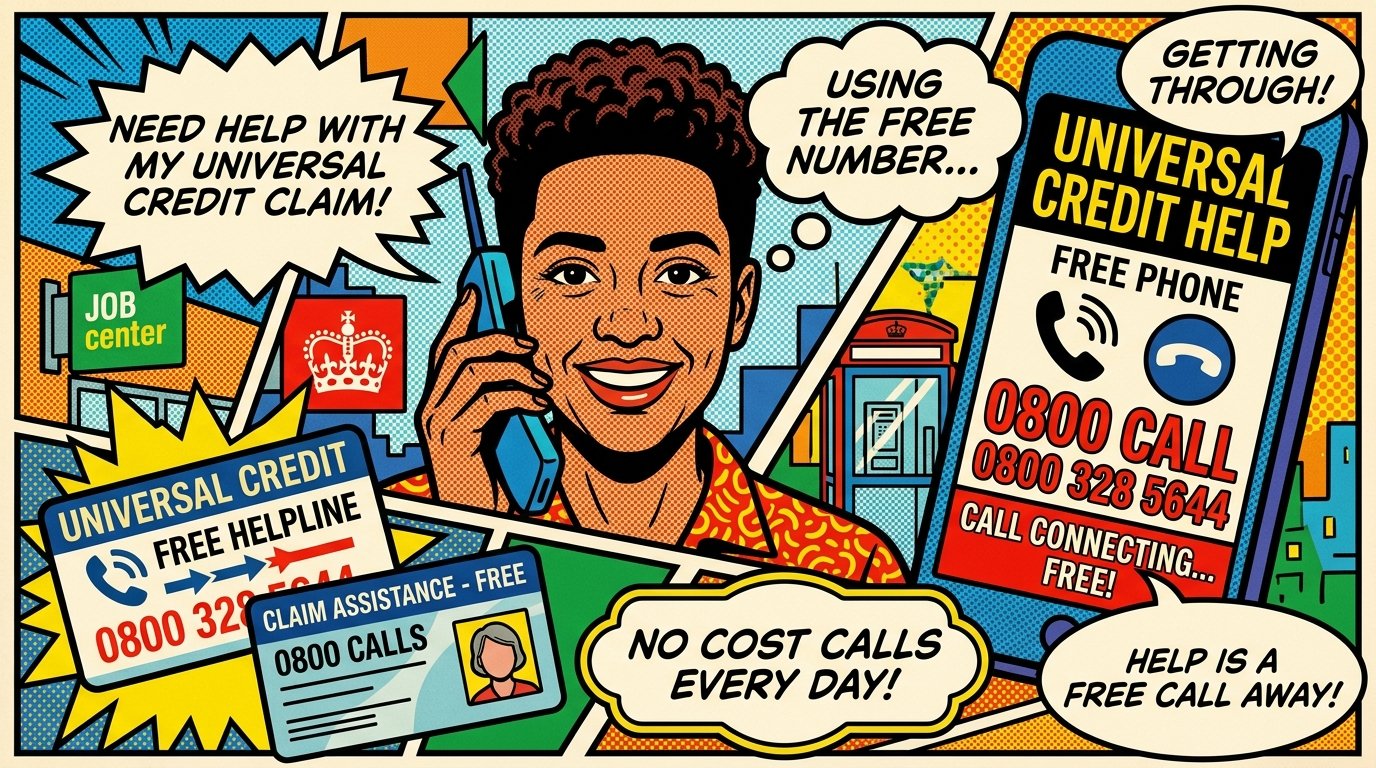
Universal Credit Free Number 0800: How to Call for Help
Introduction: Your independent guide to calling Universal Credit
If you need help with your Universal Credit claim, calling the Universal Credit free number 0800 is often the quickest way to speak to someone. The main helpline is free from both landlines and mobiles, so you do not need credit to call.
This independent guide explains the phone numbers, opening hours, and what you can ask when you call. We are not part of the DWP, so always check GOV.UK for the latest official information.
Quick answer: The main Universal Credit free number 0800 is 0800 328 5644 for England, Scotland and Wales. In Northern Ireland, call 0800 012 1331. Lines are open Monday to Friday, 8am to 6pm (closed on bank holidays).
Who can call the Universal Credit helpline?
Anyone with a Universal Credit claim or query can call the helpline. You do not need to be a current claimant to ask about making a claim.
Current claimants: Use the helpline to report changes, ask about payments, request an advance, or get help with your online journal.
New claimants: If you cannot apply online, you may be able to claim by phone. You will need a reason, such as a disability or difficulty using computers.
Someone calling for you: You can ask a friend, relative or adviser to call on your behalf. You usually need to be with them to answer security questions.

Nation differences:
England, Scotland and Wales: Call 0800 328 5644.
Northern Ireland: Call 0800 012 1331 for the Universal Credit Service Centre. Lines are open Monday to Friday, 9am to 4pm.
Welsh language: Call 0800 328 1744 for a Welsh-speaking adviser.
There is also a separate Migration Notice helpline on 0800 169 0328 if you are moving from tax credits or other legacy benefits to Universal Credit. This is a different number from the main helpline.

If you need help making a new claim, see our guide to the Help to Claim service from Citizens Advice.
How much could you get by calling?
Calling the helpline itself is free. There is no charge for the call from a UK landline or mobile.

However, the helpline can help you apply for payments that affect your Universal Credit. These include:
Advance payments: You may be able to get up to 100% of your first estimated Universal Credit payment if you are waiting for your first payment.
Hardship payments: If your Universal Credit has been reduced or stopped due to a sanction, you may be able to get a hardship payment.
Budgeting Advance: If you are already getting Universal Credit, you may be able to get a Budgeting Advance for a one-off cost. The maximum amounts are usually £348 (single, no children), £464 (couple, no children) or £812 (if you have children). [VERIFY: Northern Ireland Budgeting Advance amounts may differ.]
Important: Advances and hardship payments are loans. You usually repay them through deductions from your future Universal Credit payments.

If you are struggling with repayments, see our guide to managing Universal Credit deductions.
How to call: step by step
Check your query. Decide what you need help with. Have your National Insurance number and any relevant documents nearby.
Dial the correct number. For England, Scotland and Wales, call 0800 328 5644. For Northern Ireland, call 0800 012 1331.
Wait for an adviser. Lines can be busy, especially on Mondays and after bank holidays. Try calling earlier in the day or later in the afternoon.
Explain your situation. Tell the adviser what you need. They may ask security questions to confirm your identity.
Note down any reference numbers. Write down the date and time of your call, the adviser’s name, and any reference numbers they give you.
Documents you’ll need: a checklist
- □
National Insurance number
- □
Date of birth and address
- □
Bank account details (if asking about payments)
- □
Any letters or decision notices you have received from the DWP
- □
Your online journal login details (if you have them)
If someone is calling on your behalf, they may need your explicit consent. You can give this through your online journal, by speaking to your work coach, or by calling the helpline with the person present.
Common mistakes that delay or reduce claims
Calling the wrong number. The main helpline is 0800 328 5644. Do not confuse it with the Migration Notice helpline (0800 169 0328) or the Help to Claim line (0800 144 8444).
Calling outside opening hours. The helpline is closed on bank holidays. If you call then, you will not get through.
Not having your details ready. The adviser will need to verify who you are. Have your National Insurance number and personal details to hand.
Forgetting to ask for explicit consent. If someone else is calling for you, make sure the DWP has your permission to speak to them. Without consent, they will not share information.
Not noting down what was said. Always write down the date, time, and what you were told. This helps if you need to follow up later.
If you are having problems with your claim, see our guide to complaining about Universal Credit.
What happens after you call?
If you are calling to make a claim by phone: The adviser will take you through the application. They will verify your identity and may book your first appointment with a work coach. [VERIFY: current processing times for phone claims.]
If you are calling about an existing claim: The adviser will either resolve your query or tell you what happens next. Some issues can be sorted on the call. Others may need to be referred to a decision maker.
If you are asking for an advance: You will usually find out the same day if you can get one. Payment is usually made within three working days.
If you disagree with a decision: The helpline can explain how to ask for a mandatory reconsideration. You usually have one month from the date of the decision to ask for this.
If you need to challenge a decision, see our guide to mandatory reconsideration for Universal Credit.
Related support you might be missing
The helpline is not the only source of help. You may be able to get free, independent support from:
Help to Claim (Citizens Advice): Free support to make a new Universal Credit claim. Call 0800 144 8444 in England and Wales, or 0800 023 2581 in Scotland.
Advice NI: Free benefits advice in Northern Ireland. Call 0800 915 4604.
Local council support: Some councils offer Household Support Fund payments. [VERIFY: check your local council website as schemes vary.]
Food bank referrals: Ask your work coach or call the helpline for a referral to a local food bank.
Quick summary checklist
✅ Universal Credit free number 0800: 0800 328 5644 (England, Scotland, Wales).
✅ Northern Ireland: 0800 012 1331.
✅ Welsh language: 0800 328 1744.
✅ Opening hours: Monday to Friday, 8am to 6pm (closed bank holidays).
✅ Calls are free from landlines and mobiles.
✅ You can ask for an advance, report changes, or get help with your journal.
FAQs
What is the Universal Credit free number 0800?
The main free number is 0800 328 5644 for England, Scotland and Wales. In Northern Ireland, call 0800 012 1331. Calls are free from UK landlines and mobiles.
Can I call Universal Credit on a weekend?
No. The helpline is open Monday to Friday, 8am to 6pm. It is closed on bank holidays. You can use your online journal at any time.
Can someone else call Universal Credit for me?
Yes, but you usually need to give explicit consent first. You can do this through your online journal or by speaking to your work coach. Without consent, the DWP will not share information.
What is the Help to Claim number?
Help to Claim is a free service from Citizens Advice. Call 0800 144 8444 in England and Wales, or 0800 023 2581 in Scotland. It helps with new claims.
Can I get a Universal Credit advance by phone?
Yes. Call the Universal Credit helpline to apply for an advance. You will usually find out the same day if you can get one. Payment usually arrives within three working days.
Conclusion
The Universal Credit free number 0800 is 0800 328 5644 for England, Scotland and Wales. It is free to call, and lines are open Monday to Friday, 8am to 6pm. In Northern Ireland, use 0800 012 1331.
Calling the helpline can help you with payments, advances, changes, and problems with your claim. But it is not the only source of support. Citizens Advice, Advice NI, and your local council may also be able to help.
For more help, see our guides on Universal Credit advance payments, Help to Claim, and what to do if your Universal Credit is stopped.
Disclaimer: This is an independent informational website. We are not affiliated with, endorsed by, or connected to the DWP, HMRC, any UK government body or local council. Information is for general guidance only and is not financial or legal advice. Always check GOV.UK for the latest official information.
[LAST CHECKED: 12 October 2026]